Monday, July 23, 2007

Walter Worms and Banana Worms

The two live food cultures I had ordered for my baby killies (when ever I get some to hatch) are walter worms and banana worms. They arrived in little containers and smelled a bit like vinegar. I am guessing the seller sent me a portion of an older culture so that there would be plenty of worms. When they arrived, I went out and bought my supplies to get my cultures going. What was needed included: sandwhich sized food storage containers, baby cereal, and a ripe banana

I poured about a 3/4" thick layer of gerbers baby cereal into 2 containers (one for walter worms, and one for banana worms). I poured in some water that I first ran through a brita filter and mixed it with a fork. I kept adding water until the mixture was pasty and easily worked, but not watery. Then, in one of the containers I added a 1/4 peice of a ripe banana and mushed that into the mixture. I mixed it up well so the banana was evenly spread through the baby cereal. I smoothed the top of both down. Banana Worms

The next step was to add the worms. In the container I mixed the banana into, I added the banana worm starter. I did my best to spread it evenly over the surface so all the worms could get food. I Walter Wormsadded the walter worms in the same way to the other container.

It has been a couple of days since I set up the cultures and if I hold them up to the light and look closely I can already see a ton of tiny worms moving around. They look more like little bits of glistening light. The worms should be kept in a dark, warm place, but should not be kept above 85*f.

To harvest some worms to feed, simply wipe them off the sides of the container. Once the culture has been going for a few days they should start to climb up the sides. A finger or popsicle stick works and you can either swish them directly into the fry tank or into a jar of dechlorinated water, and then use a dropper to feed them. They will live for 24 hours, possibly a bit more, in the tank water. This makes them a great food as they won't foul the water as quickly as some other foods.

According to the seller in about 10 days the culture will start to smell vinegery. At this point I should add a little it more baby cereal to the cultures to keep them going for a couple more weeks. Before I add the new cereal however, I should start up a new culture of each, so that when the old culture dies off, I will have a new one going. By continually doing this I can always have live foods available for newborn fry. Overall these seem like an easy to culture and feed live food for newborn fry. They are small enough for the smallest fry and even slightly bigger fry, like livebearer fry would probably like them.

Thank you to fishguy_1955 on aquabid for the great culture starters and great service:)

The Basics Of CO2 Injection For The Planted Aquarium

The Basics Of CO2 Injection For The Planted Aquarium

Providing some form of carbon to plants in a high light system is a necessity. Plants utilize carbon during photosynthesis to produce glucose, which is what the plants use for energy. In a high light situation the plants are growing quickly and require a lot of energy to maintain health and the quick growth, therefor they need a lot of carbon. One of the easiest ways to add supplemental carbon to your planted aquarium is via the use of carbon dioxide (CO2). If you have a low light tank additional CO2 is not usually neccessary. If you feel your plants in a low light tank are needing a carbon source try flourish excel.

DYI Yeast CO2
There are a couple ways to do add CO2 to your planted aquarium. One is to mix yeast, sugar and water in a container and run tubing from the container to the tank to some kind of "reactor". A reactor can be anything that delays the CO2 from reaching the surface of the tank, so that it can dissolve into your aquarium water. There are many different ways to make a "reactor", I will touch more on that below. If you do not want to make your own system you can purchase a ready made one like Hagen's Nutrafin Co2 Natural Plant System from your local fish store. Using the yeast method to get CO2 can work in smaller tanks, but the CO2 production is unstable and unreliable. For larger tanks it can become very time consuming making up enough bottles to keep up with your CO2 needs. Many people start out with yeast CO2 but soon tire of constantly having to remake the bottles of yeast, sugar and water.

Pressurized CO2
This is where pressurized CO2 injection comes into play. With pressurized CO2 you have a cylinder ( aka tank) of liquid CO2, a regulator, a needle valve, a bubble counter (optional), and a CO2 diffusion reactor.

The Cylinder
CO2 cylinders are designed to hold liquid CO2. The pressure of a CO2 cylinder, filled is about 1,000 psi. It is important to use a cylinder that is specifically made to hold CO2 as others may not be able to handle the high pressure needed to keep the CO2 in liquid form. CO2 cylinders can be found in sizes from 2.5 pounds to 20 pounds. The most common size is 5 pounds. These can be found at wielding supply stores and beverage distributors. The cylinder may come in aluminum or steel. Both will work fine, the aluminum is lighter and does not rust, but cost more than the steel normally. Ideally you will want to buy a cylinder that is already filled, that you can take back to exchange for another one that is filled once yours is empty. If you purchase an empty cylinder you will need to find a place to fill it and you will also need to get it inspected regularly. The CO2 cylinder needs to remain in an upright position. Tipping it to the side can prove detrimental.

The Regulator
The regulator reduces the pressure coming from the cylinder to a more useable pressure. You will want a regulator that has a dual gauge. One side of the gauge tells you the pressure inside the cylinder, which will tell you when it is empty or almost empty, the other side tells you the pressure you are using, which you can adjust. A good quality regulator is important. When the tank gets close to empty the pressure decreases and this can cause the rest of the CO2 to suddenly leave the cylinder. This is called an "end of the tank dump". This will kill your fish. A good quality regulator will prevent this from happening.

The Needle Valve
The needle valve allows you to have more control on the amount of CO2 that you are putting into your tank. You want to be able to fine tune the amount of CO2 to keep it at the desired levels. To low and your plants will be lacking, to high and your fish will be floating. A guality needle valve will also help to prevent an "end of the tank dump".

The Bubble Counter
The bubble counter is an optional piece of equipment, but is very useful. The bubble counter allows you to see how many bubbles per minute are going into your tank. This allows you to fine tune the amount even more. Once you find out how much CO2 a certain amount of bubbles per minute gives you, you can adjust the flow without having to figure out the CO2 amount in your fish tank.

The Reactor
The CO2 diffuser/reactor is what mixes the CO2 into your aquarium water. There are many ways to do this. Some involve running the CO2 line to a power head or internal filter, which will make the bubbles smaller, providing more surface area for the CO2 to diffuse. Others are containers you put into your tank that hold the CO2 down in the water, allowing it to dissolve. Another way is to run the CO2 into a canister filter, this allows the water and CO2 to mix before going back into the tank. This allows CO2 rich water to run into your aquarium. There are many other ways to diffuse CO2 as well.

Another optional piece of equipment is a solenoid valve. Using this you can close off the CO2 at night and reopen it during the day without having to adjust your needle valve or the valve on the cylinder. Closing it off at night will preserve CO2 as the plants utilize oxygen (during respiration), rather than CO2 at night. Plants also produce CO2 at night, so adding more can be bad for your fish.

Adding pressurized CO2 to a high light tank can reap many benefits. It can cost anywhere from $80 to a couple hundred dollars depending on the equipment you purchase and the general prices of your area. Make sure your equipment is safe as a large tank of CO2 leaking into your house can be dangerous. If you are using appropriate, inspected cylinders and a good regulator everything should be fine. Remember, if you have a low light tank do not add extra CO2 to the tank. The plants will not be able to use it quickly enough and it may kill your fish.

Links about yeast CO2 injection:
http://www.plantedtank.net/articles/DIY-Yeast-CO2/7/
http://www.thekrib.com/Plants/CO2/co2-narten.html
http://www.netpets.com/fish/reference/freshref/co2.html
http://www.aquariumguys.com/nutrafinco2.html

Links about pressurized CO2 injection:
http://www.dlink.org/aqua/CO2.html
http://www.plantedtank.net/articles/Pressurized-CO2/19/
http://www.aquariaplants.com/pressurizedco2.htm
http://www.bestaquariumregulator.com/co2.html
http://www.theplantedtankfaq.com/CO2_FAQ.html

Photos from:

http://www.flickr.com/photos/bereninga/317810126/

http://www.flickr.com/photos/frankllin/124224131/

Keywords: CO2, CO2 injection, photosynthesis,

Cryptocorynes


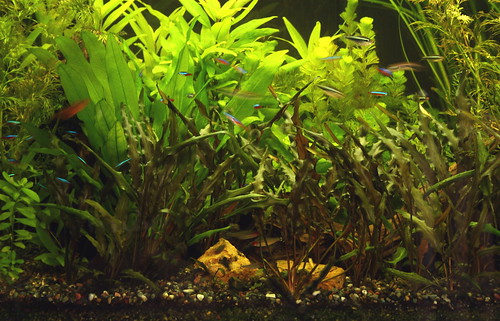
Cryptocorynes are widely spread genus of plants. They can be found from Vietnam, Malaysia, Indonesia to India and New Guinea. The number of species that are known is increasing due to chromosomal research. Many plants that were thought to be varieties are actually different species.

Many of the crypts available come from Sri Lanka. These include C. wendtii, C. walkerii (C. lutea), C. undulada, and C. becketii. In the wild these are usually found in small streams growing in various types of soil, usually in acidic water. Some of the soil types they are found growing in are sand, clay and rotten leaf litter. These crypts are not only more available but also are perhaps some of the easier types to keep in aquaria.

Cryptocorynes are beautiful plants and are popular in the aquarium hobby. Some consider them difficult to keep because of their habit of "melting" when environmental factors are changed. Often when the pant is brought home its leaves will melt and it may take a month or two before the plant recovers from the transplant shock and begins to grow again. Other things, like changing light bulbs and large water changes can cause the crypts to melt.

To successfully keep crypts, the soil or substrate in the aquarium must contain lots of nutrients. Using a substrate with a clay base will often provide most of the nutrients needed. One can also put laterite underneath the gravel bed. Crypts also benefit from the use of fertilizer tabs or sticks placed near the root system. Crypts, like most plants also need light to grow. Cryptocorynes are considered a low light plant. This means they can easily be kept under regular fluorescent lighting. They can also successfully be kept under high light conditions. They also benefit form CO2 or some other source of carbon (such as flourish excel).

To prevent the dreading "melting" that is the bane of crypt keepers, make environmental changes slowly. If you have multiple bulbs over your tank, and they need changing, change one at a time, spacing them a few weeks to a month apart. Avoid large water changes, do more frequent smaller ones instead. Also, avoid doing heavy doses of fertilizers. Smaller dosing more often will work much better with the crypts. If your soil has enough nutrients crypts do not usually need much in they of liquid fertilizers.

Over all it does not take much to keep the more commonly available crypts happy. A nutrient rich soil and slow environmental changes are perhaps the two most important things to remember.

Picture credit: Wandering Angel

Saturday, July 21, 2007

Oscar care

Oscars (Astronotus ocellatus)

Oscar Oscars are possibly one of the most widely known and most popular of the cichlids. Many people who are not even into fish know what and oscar is. Their popularity is due to their great personality and their great appetite. Oscars quickly learn to recognize their owners and are more than willing to just about anything they think will fit into their mouth. Oscars are a member of the cichlid family that get up to 18 inches long and live to be 15 years old. They are native to south american and can be found along the Amazon river. They are normally found in slower moving areas of rives, tributaries and drainages.

Tank Size
One of the first things to consider when you are thinking of getting an oscar is the tank size they will need. These large fish need a lot of room. Many people try to keep them in 55 gallon tanks, however long term this size tank is inadequate. Oscars regularly grow to be 15 inches long, a standard 55 gallon tank is only 13 inches wide. Not only do the oscars get large, they produce a lot of waste. This means they need a lot of water to dilute the waste. For one adult oscar, by itself, a minimum tank size is 75 gallons. If you want to keep multiple oscars together you will be looking at tanks well over 100 gallons in size. Generally when concerning oscars, bigger is better. Young oscars can of course be raised in smaller tanks, but they grow very quickly. Many oscars will reach a foot long by the time they are a year to a year and half old. Make sure to have a secure lid with weights or clamps. Many oscars seem to enjoy knocking the lids off of their tanks if they can, and many will also jump.

Filtration and Heat
Because oscars are such big, dirty fish they require some heavy duty filtration. Large canister filters, overrated for the size tank, work great. Make sure to clean them out monthly or they will produce a lot of nitrate. Many people combine a canister filter with a power filter. Under-gravel filters usually do not work well with oscars as they tend to like to dig up the gravel and may even go after the gravel plate. A comfortable temperature range for oscars is 75-82*f. It is highly recommended to either put your heater in an external filter or put a heater guard around it as many oscars have destroyed their glass heaters shooting rocks at them. This can be dangerous for the fish and you. To determine the size heater you need, using 5 watts for every gallon of water is usually the recommendation. However with large tanks you can usually get by with a bit less, as a large body of water is less likely to change in temperature very quickly. 3 watts per gallon for large tanks usually works well. I find it best to use 2 smaller heaters, putting one heater on each end of the aquarium for an even temperature throughout the tank. For example. for a 75 gallon tank, using two 150 watt heaters usually works well.

Feeding
While many people like to feed their oscars feeder fish this is usually not a good idea. Feeder fish are lacking in many nutrients the oscar needs and they can bring in a lot of different problems including parasites, bacteria and fungal infections. If you really want to feed your oscars feeder fish, breed your own. Using convicts or mollies usually works. Make sure to feed the feeder fish a high quality food and keep them healthy so your oscar is getting healthy food. A better way to feed your oscar is with a large variety of pelleted and frozen foods. Feeding a few different high quality brands of pellets, along with krill, blood worm cubes and seafood from a grocery store will help keep your oscar healthy. One of the pelleted foods should be a plant based food to insure your oscar is getting his vegetables:) Baby fish under 4 inches should be fed 2 to 3 times a day. Adolescent fish, between 4 and 8 inches can be fed 1 to 2 times a day. Fish 8 to 12 inches can be fed once a day and adult fish 12 inches and large can be fed every other day. Feed until the oscars belly looks slightly rounded. The oscar may appear to keep eating even after this point, but most of the food will end up coming out the gills and dirtying the tank even faster.

Decorations
Decorations should be minimal as oscars tend to like to move things around. Avoid heavy object that could fall on them as they move gravel around and avoid large stones they can pick up as you may come home one day to find your tank shattered and your fish and water on the floor. Generally, a piece or two of driftwood and some well made fake plants work well. Remember that oscars are big fish so do not take up a lot of room with decor. When cleaning, make sure to clean under and around all decorations and debris tends to accumulate there.

Cleaning

As stated before, oscars are very dirty fish and also need very clean water. Dirty fish need to have their tanks cleaned often. For an appropriately stocked and filtered oscar tank (ie: a 75 gallon, over-filtered with 1 oscar) you should change about half the water weekly. This may seem like a lot, but oscars really are dirty fish. They are also sensitive to poor water a quality. If your tank is over stocked, twice weekly or more change half the water. Having a test kit will help you determine if you are changing enough water. Ammonia and nitrite should both be at 0 at all times. Nitrates should be kept, ideally, under 20ppm. The pH is not of much concern as long as it remains stable. When doing a water change make sure to vacuum the gravel well. I find it easiest to do one half at one water change, and the other half the next, alternating back and forth between the two sides. The filters should be cleaned at least once a month, sometimes twice a month, depending on how dirty they get.

Tank-mates
If given a large enough aquarium there are many fish that are compatible with oscars. Some include bala sharks, tinfoil barbs, jack dempsys, pacu (if you have a very, very large aquarium),Green Severum silver dollars, larger clown loaches, most larger catfish, severums , chocolate cichlids and more. To keep oscars with other fish, especially if they are cichlids, a 150 gallon tank or larger is recommended. Make sure the fish are close in size to the oscar so they are not viewed as a potential snack. If you want to keep oscars together, keep either a pair, or keep 6 or more. Often if you only have 3 or 4, the dominant ones will constantly harass the weakest one until it dies, and then the next weakest and so on until you are left with only one or two oscars. Because a tank large enough to keep 6 adult oscars together is not usually feasible, it is best to keep them in a pair, alone or with other compatible fish.

Varieties

Albino OscarOscars now come in a few different varieties. These include, red oscars, red tiger oscars, albino oscars, gold oscars and long finned oscars.

Photo Credits:

http://flickr.com/photos/staceydicks/327737605/

http://flickr.com/photos/marcuspajp/88333757/

http://flickr.com/photos/everyskyline/538968810/

http://flickr.com/photos/firemouthus/146140966/

http://flickr.com/photos/everyskyline/538968884/

Monday, July 9, 2007

Trying a new fertilization regime, Estimative Index

I am going to give the estimative index fertilization a try. I do not want to do such large weekly water changes though so my doses are going to be a bit lower than recommended. I am planning on weekly 30% water changes on my 60 gallon tank (so roughly 18-20 gallons a week). Estimative Index recommends 50% weekly water changes. I do not think my crypts will like that, and I just don't want to do that much.

Tank stats: 60 gallon heavily planted 110 watts PC and 64 watts of normal output (regular) fluorescent lighting (2.9 watts per gallon, but 1.8 of it is PC light) - 12 hours a day 3 Hagen yeast CO2 systems, changed every 3 weeks Substrate is 4-5 inch gravel bed with 60 grams of laterite

My fertilizer regime is going to go like this:

Sunday, Tuesday, Thursday : 1/4 tsp of KNO3, 1/16 tsp of KH2PO4, 1 capful flourish excel

Monday, Wednesday, Friday : 1/16tsp of trace elements (CSM+B Plantex), 1 capful flourish excel

Sunday am : 18-20 gallon water change, 1/4 tsp GH booster (has Potassium Sulfate, Calcium Sulfate and Magnesium Sulfate). Start over with dosing regime.

Every 3 months : 3 flourish tabs (at the base of swords and crypts)

I just purchased my fertilizers from www.aquariumfertilizer.com, so I will be starting once they get here. I may find I need to up my doses a bit, but we shall see how this goes. I am concerned I may need to add extra iron, but again we will see. If it is needed I will probably just use Flourish Iron and start at 1/3 the dose they recommend since the trace elements should have some iron in it. I may also find I do not need the GH booster. I plan to test my GH weekly for awhile and see what it does. This should be an interesting experiment.

Links about estimative index:
The Barr Report - Estimative Index
Greg Watson's Aquatic Plant News - Estimative Index

Aquatic Plant Central - Estimative Index Dosing Guide


I also posted some of this on aquariphiles.com and google's TFA group