You've decided to take the plunge . . . you want an aquarium. So its easy right? You just go to the local fish store and grab a 10 gallon tank, a cheap filter, a heater some gravel and decorations, you think your all set. A couple of months later you are dismayed that your tank is full with only 8 or 9 small tropical fish, you have had to upgrade to a better filter and you couldn't get the fish you really wanted because they would get too big or aggressive for a tank of your size. Many people start out in the hobby this way. There is however a better way to go about it. It involves doing some research and waiting a little bit before getting your first aquarium.
Step One
The first step to acquiring an aquarium that you will be happy with is to go to the local fish stores and look at the fish. Bring a notepad and a pen with you and give yourself a good amount of time. Just look at the fish for awhile, write down the names of ones you like. Make notes about what it is you like about them. Maybe its the way they all swim together, perhaps the color, possibly the way it comes up to glass and looks right at you. Once you have gone to several local fish stores and have a good list of fish you can move on to step two.
Step Two
Now that you have a long list of fish that you like its time to jump online and do some research. Usually finding a good online fish group, such as TFA will be helpful in this area, you can ask questions and get answers from knowledgeable hobbyists. Things you want to find out about each type of fish are adult size, water chemistry needs (such hardness and pH), dietary needs (will the
Step Three
Purchase your aquarium! All the hard work and research is done with and you can finally 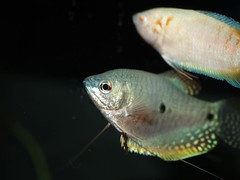
Doing some research ahead of time will make the aquarium hobby a more pleasant experience for you and the fish you decide to keep. Have fun with it!
Picture credits:
Thursday, July 10, 2008
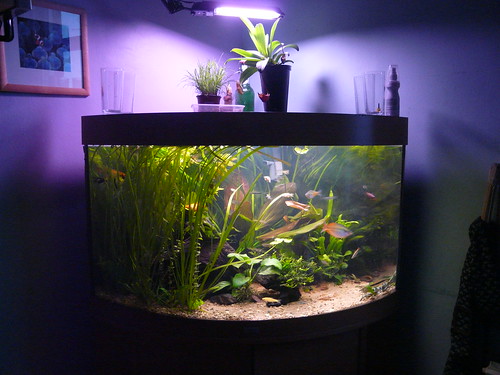
Selecting Your First Aquarium


Saturday, February 23, 2008
Enrichment
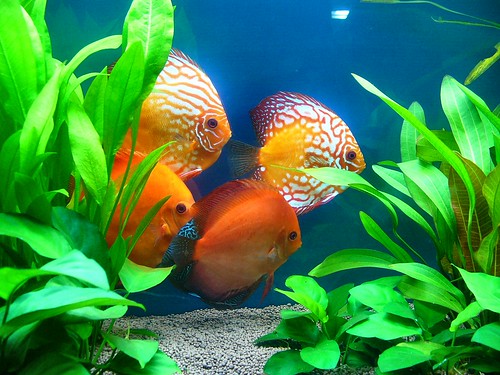
When people talk about enrichment and animals they are usually talking about enriching the lives of creatures like tigers, apes and parrots. Often not much thought is given to enriching the lives of fish. Many fish however have been shown to have some intelligence. Even guppies can count to the number four! Cichlids have often been considered very intelligent fish and many would do well to have some enrichment. With this in mind, perhaps it is time to start looking into how we can enrich the lives of our aquatic pals.
What is enrichment?
When we talk about enrichment concerning animals we are referring to improving their lives, stimulating them. Enrichment is a common topic among many institutions, such as zoos, that have animals. When looking to enrich an animals life its a good idea to start by looking at how they would normally behave in the wild and try to offer things that may trigger similar behaviors. For example, with many mammalian predators, keepers will often hide their food so they have to "hunt for it". Or they will put in large balls or other things that move when the animal touches it and this stimulates a prey drive. Primates are often offered puzzles and other things that stimulate their intellect. Without enrichment many captive animals become extremely bored, obese and some may even exhibit bizarre behaviors.
Enriching The Lives Of Fish
So, how would one go about enriching the lives of fish? Well, that would depend on the type of fish. For many fish, simply having tankmates and an interesting environment with a lot of visual barriers will be enrichment enough. For others you may need to get creative and utilize ping pong balls, a mirror or even a squeaky toy! Food can perhaps be one of the best enrichment tools available to animal keepers, try to get creative.
Tankmates
Tankmates can provide plenty of entertainment for many fish. Schooling fish such as barbs, tetras, rasboras and many more benefit most from being in groups of 6 or more of their own kind (for example, 6 neon tetras, not 1 each of 6 different tetras). They will spend most of their day reacting to each other, displaying, and working out their social hierarchy. Rock dwelling African cichlids spend much of their time in both the wild and captivity stealing and protecting favorite rock outcroppings and caves from each other. If your lone fish seems sedentary and bored with life, consider upgrading its tank size and adding some tankmates. Remember to research first what types of fish can live together.
Use fake or live plants, driftwood pieces or other decorations to create a dynamic aquascape. Try to position decorations so that if the fish is in one section of the tank, it cannot see the other side without moving. This will stimulate most fish to always be on the move to check out what's "over there". If you have multiple fish this can also be a necessity, as it will give fish a break from each other if the needs arrives. Many fish, like botias and loaches love to check out caves and little nooks and crannies. You can make an interesting cave and tunnel system with PVC pieces, just make sure they are big enough in diameter that the fish won't get stuck. African cichlids also often enjoy PVC pieces. If you want a more natural look, use rocks and aquarium safe wood instead of PVC. For top dwelling fish, add floating plants (live or fake) and perhaps add a piece of wood that reaches all the way to the surface.
You need a big enough space to create an interesting environment. Try to avoid overstocking your tank with many small fish. If you have large fish, ensure the aquarium is large enough for the fish and some decorations.
Toys
Many large fish are kept by themselves because of the amount of tank space it would take to have appropriate tankmates. Oscars are a prime example. Many live alone in 75 gallon tanks with not much to do all day. Other fish live alone because they are aggressive or because they can survive in a smaller tank that only has room for one fish (bettas for example). Many of these fish are some of the most intelligent, and yet they are often the ones relegated to the most boring existence. Many of these fish will benefit from toys to play with, yes toys. Many larger cichlids will "play" with a floating ping pong ball, or will check out and manipulate with their mouths new items in their territory. One oscar seemed to enjoy a dog toy, it was a small squeaky toy. The oscar would carry it around, biting on it. Some toys can be used to hide food in, so the fish has to work to get its meal. If you decide to use a toy for your fish, make sure it will not negatively affect the aquarium water. With bettas, holding up a small mirror for a minute or so a day will initiate a threat display and give the betta some excellent exercise. They often appear to "feel proud" of themselves when the mirror is put away, for having chased away the opponent. You can even teach your fish to do tricks . . . such as play soccer, basket ball, or swim through hoops.
Food As An Enrichment Tool
Food can perhaps be one of the best enrichment tools available to keepers. One of the biggest delights of many aquarium keepers is feeding time. The fish become animated, excited. Its nice to see them enjoying something. Most people just toss in some flakes or pellet foods and in a minute, or even just a few seconds, it is over. In the wild fish have to work for their food. Finding and getting food preoccupies much of their day. In captivity it is something that takes up perhaps just a few seconds, once, maybe twice a day. So, how do you go about making eating more interesting? Well, that will depend on how your fish eat. You would feed a top dwelling fish differently than a bottom dweller and grazers differently than a predator.
Try adding live foods fairly often, such as brine shrimp. They will have to hunt them down and will often spend some time after they have eaten them all, looking for more. If brine shrimp are too small for your fish, try ghost shrimp instead. If you don't have access to live foods, put frozen foods into the filter current so they have to chase them down. Feed different types of foods, alternate between a flake food, a floating pellet and a slow sinking pellet. Feed in a different area, alternate sporadically between the left of the tank, the right, the middle, the front and the back. Try adding a live food that can survive and breed in the tank, such as a species of fresh water shrimp. Some people have successfully been able to keep a small population of daphnia alive in their aquarium. For bottom dwelling and grazing type fish (catfish; goldfish), drop one pellet here, one there, don't just drop them all in one spot. For predators, put food on the end of a feeding wand an make them stalk and hunt down their food. Many herbivorous fish, such as goldfish or silver dollars, will enjoy eating live plants; drop a bunch of anacharis (elodea) in the tank once in awhile. Some fish can learn to put a ball through a hoop or ring a bell to get fed. Again, just be creative and mix it up, your fish will appreciate it.
When it comes to enriching the lives of our aquarium fish it can be as simple as adding some tankmates and decorations, or as complicated as giving them toys to chase and push around, or rigging up an underwater basket ball game. Even the simplest forms of enrichment can make a huge improvement on their lives.
Interesting links:
Underwater Times: Man Trains Goldfish
Fish School - How To Train Your Fish
Picture credits:
loloieg, doviende, Whisper Photography, Tom@HK

Saturday, February 9, 2008
Dealing With Burn Out
Dealing With Burn Out
Burn out
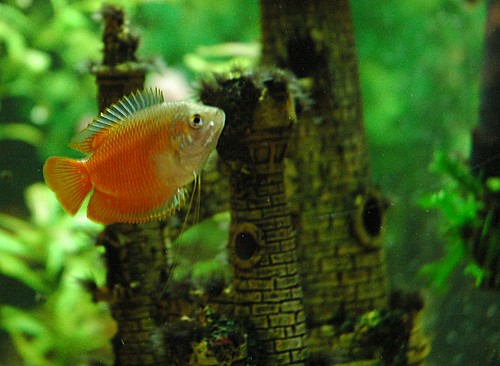
No, I'm not referring to water dripping onto one of your many electrical strips, I am talking about something that happens to many hobbyist at one point or another. As you are going along doing your water changes you suddenly realize that your tanks have turned into a chore rather than a pleasure. You used to get a thrill out of your tanks, seeing baby fish or a new plant pop up. Now when you gaze in the direction of your tank or fish room you get a long list of "to-dos" popping up in your head. You find yourself avoiding the tanks, diverting your eyes from the multitudes of little fish. You go longer between doing your water changes, you aren't as diligent about dosing your fertilizers or supplements. Your bulbs go unchanged. You derive little pleasure from you once highly enjoyed hobby. What happened? You have burned out.
Whats The Cause?
Burn out can happen to anyone, whether they have one tank or hundreds. Whether they have been in the hobby for 20 years or one. What causes it? Well, that is probably different for everyone. As humans our interests do change over time. Perhaps you now find that orchids or glass blowing gives you your thrills. Maybe your life has become busy and time is just something you don't have to spare. For some people, once their tanks are set up and they are not out buying new fish and selecting plants and researching who can live with who boredom sets in. What ever the cause, it does happen.
How To Handle It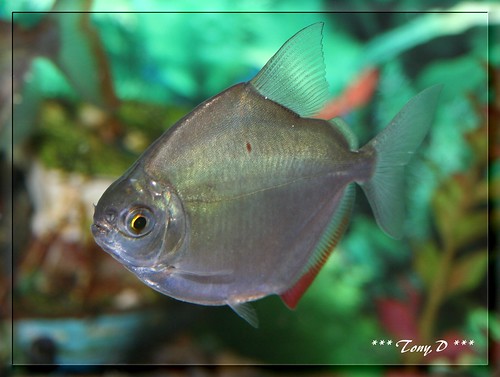
1. New is exciting, redo your tank. Trade your fish in, redecorate and try different fish. Setting up a new tank is often very exciting for people and this may just be what you need. If you have been keeping fancy guppies forever, try something completely different, like cichlids. If you are keeping a reef tank, try switching to fancy goldfish. A change may just be your cure.
2. Join an aquarium club. Excitement and enthusiasm are contagious! Surround yourself with others who enjoy the hobby. You can get new ideas, trade fish and just have a good time chatting about the hobby.
3. Spend time just enjoying your tank. If all you do is maintenance on your tank and you never sit back to enjoy the fruits of your labor it can be very easy to burn out. Try moving your tank somewhere that you can easily see it.
4. Try less tanks. If you have a huge fish room with tons of tanks all over, try taking some down and focusing on just a few display tanks or on just breeding a couple of species that interest you.
5. Go to the next level. Have you mastered keeping the tropical community tank? M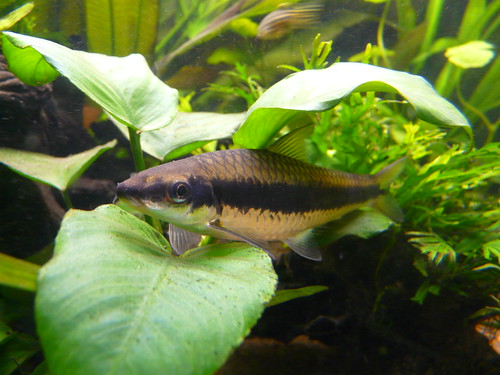
6. Make it easier. Invest in automatic water changing systems, feeders and dosers or hire someone who does tank maintenance. If you have less work to do on your tank you will probably enjoy it more, not to mention that playing with new gadgets is always fun. Also, this way, if you are burnt out your fish will not suffer the consequences.
If you find you just can't muster up enthusiasm for the hobby you once enjoyed, perhaps it is time to take a break. Remember that the fish rely on you for their survival and if you are dreading working your tank you are less likely to take as good care of it. Besides, why do something you don't enjoy? Many people find they just need a break for a couple of years. If you decide you need a break, I highly recommend you keep all of your equipment in storage as the fish bug often bites again.
Photo credits in order of appearance: nellring, tkcrash123, threefingeredlord
Friday, May 11, 2007
Supporting Local Fish Stores
I like to support my local fish stores (LFS) over the big chain stores when ever possible. I know of many people who will go to the big chain because their products are dollar or two cheaper, but then go to the small local fish store for advice and fish only. Did you know that petstores (fish stores) generally make very little or no profit on the live animals they sell?
Local fish stores (LFS) are often more knowledgable and care more because they are actually hobbyists. They got into the business because they enjoy the animals. If you want to have that source of good knoweledge people and a healthy variety of fish (rather than just the staples the big stores usually have) and the ability to possibly requests certian kinds of fish, then support your local fish store! If there is a big price difference from the big chain and LFS (local fish store) ask the manager or owner at the LFS (local fish store) if they will price match or give you a discount on the item. If its only an extra dollar or two then that money would be well spent to keep your LFS in business. Think of it as payment for their advice and larger fish selection. If you don't see an item you want or need, ask if they can order it. Many fish stores will be more than happy to order an item for a customer and may even consider carring it if they know people want it.
Think about it, if you want to have that LFS around to buy fish from, get advice from, take your kids to, then they need to stay in business. Buying your fish there does not keep them in business, they make their profit (and very little profit after overhead costs) on their hardgoods (filters, heaters, fish food and so on). Please support your local stores or we will lose them all.
Links about supporting your LFS:
http://www.thinkfish.co.uk/pages/Supporting_Your_Local_Shop.html
http://www.thekrib.com/Misc/online-retailers.html#1
Thursday, May 10, 2007
Anomalochromis thomasi

The picture is of one of the 4 Anomalochromis thomasi (fish) that lives in my 60 gallon planted aquarium. These little guys (fish) are full of personality and are very amusing to watch. They are one of my favorite little fish. The one in the picture is the more bold of the four. He or she will stick around to check things out (like the scary camera phone!) a bit longer than the other 3 fish, who high tail it into the thick plant growth the minute they are scared.
Sometimes called butterfly cichilds (fish). They are very pretty with an irredesent blue and red coloring to them, with darker spots or vertical stripes on their sides. They aren't to aggressive, they will occasionaly give chase to other fish but rarely do more than that. These fish tend to stay to the lower portions of the aquarium and are always busy checking something out. They seem to be very observant of their surroundings. Often while I am watching them, they are also watching me. They go nuts over shrimp pellets.
From what I have read these fish do best in lower pH water, but mine do just fine at a pH of 7.6-7.8. They probably just won't breed. Temperatures in my tank (aquarium) flucuate from 78*f-81*F.
From wikipedia:
Anomalochromis thomasi is a species of fish in the family Cichlidae, the only species in the genus Anomalochromis. It is a small cichlid growing to a length of 6-8 cm. The natural habitat of A. thomasi is Sierra Leone and Liberia, mainly in smaller streams. The fish are typically found in slightly acidic, oxygen rich water with other west African cichlid genera such as Hemichromis and Pelvicachromis.
links about A. thomais:
http://www.thekrib.com/Apisto/A-thomasi.html
http://www.thecichlidgallery.com/a.thomasi.htm
http://fish.mongabay.com/species/Anomalochromis_thomasi.html


