Montezuma Sword-tails (Xiphophorus montezumae)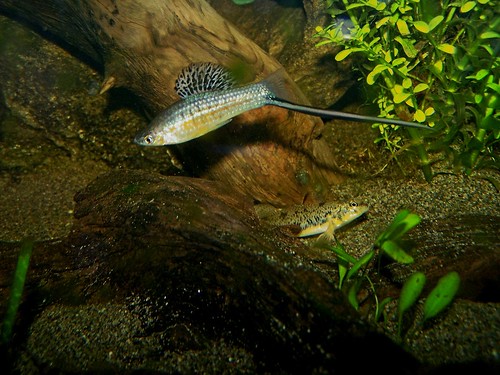
Captive Care
Montezuma sword-tails (often called "monties") are fairly easy to keep happy. They should be kept in groups with a ratio of one male to every 2 or more females. A 30 gallon long style aquarium can house a group of up to 6 adults. The aquarium should have some areas that densely planted (with live or fake plants) and some open areas. If you have enough cover, fry will survive with the adults.
Water Quality
As with all fish, stable, clean water is the most important to these pretty sword-tails. As long as the water is parameters are stable and the water is clean (no ammonia or nitrites, low nitrates, low dissolved solids) they should be able to adapt to most pH and hardness levels. Having said that, it is probably a good idea to keep their pH above 7.0 and below 8.0 and the dH between 10 and 20. They seem to handle temperatures between 68*f to 82*f fairly well. They may not breed at the lower and higher ranges, but that is just a guess. If kept in the higher range, remember to add extra aeration as warmer water does not hold oxygen as well as colder water. Also, never lower temperatures more the 2*f every few hours and do not raise them more 4*f every couple of hours. Stability and avoiding extremes is the most important thing.
Food
Monties are not picking about what they eat from what I have seen. As with most fish they do best on a variety. Use a couple of different flake foods (I suggest one brine shrimp flake, one spirulina flake and a generic tropical flake) and supplement with live foods (brine shrimp, clean blood worms, mosquito larvae, fruit flies, be imaginative!) and with frozen foods (brine shrimp, blood worms, mysis shrimp . . .). If you give them good nutrition and good water they should grow and breed for you.
Tank Mates
If you wish to keep monties with other fish, avoid mixing them with other sword-tails or platies or you may get some hybridization. They can safely be mixed with goodeids and I believe fish in the genus Poecilia. They can also be mixed with some peaceful tetras (stay away from nippers, the long swords are very tempting!), and peaceful bottom feeders such corydoras catfish. You can try a variety of tank mates, just remove any that aren't working out.
What Makes Monties So Special?
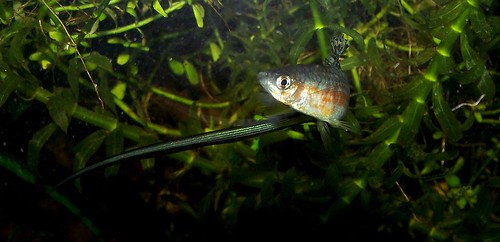
Perhaps the most stunning feature of montezuma swordtails is, well, their sword! Mature males will often have swords that are longer than their body. Even young males have long swords that usually equal the length of their body. Not only is their sword impressive, but they are not a drab fish. Even the females are nice to look at. Their dorsal fins are rather tall and they are not usually shy to display!
A Confusing Past
In the past a different fish was being masqueraded in the aquarium hobby as montezuma sword-tails. This fish was X. nezahualcoyotl. This other sword-tail has a shorter body and much shorter sword. In 1980 the true montezuma sword-tail was rediscovered in Mexico and the confusion was straightened out. Since the rediscovery monties have experienced a big rise in popularity, this popularity boom can be greatly attributed to the males extremely long sword. To read an excellent little two part series of articles on the history of the montezuma sword-tail and on the variation of color I highly recommend joining the ALA (American Livebearer Association) and ordering issue #196 and #197 of their bimonthly bulletin, Livebearers.
These guys are a gorgeous wild type swordtail. A friend of mine has a small colony of mottled monties and they are stunning! Someone was nice enough to send me some fry, so I now have some little babies swimming around my tank. They however are mostly looking to be males. I may have 2 females, but the others are boys for sure. Once they are bigger, I will probably trade extra males into the local store and order a few more females online.
Credit for the awesome montezuma sword-tail pictures goes to scott361
Showing posts with label swordtail. Show all posts
Showing posts with label swordtail. Show all posts
Friday, January 25, 2008
Montezuma Sword-Tails (Xiphophorus montezumae)

Monday, July 23, 2007
Common Livebearers
Live bearers are often one of the first types of fish people get when starting out in the aquarium hobby. It is exciting to have new baby fish so easily! They are very colorful and active, which draws new hobbyist to them. The livebearers most people start out with belong to the family Poeciliidae.
Poeciliidae is considered a livebearing tooth-carp family. They originate from North, Central and South America. Many have been introduce to nonnative areas. The most commonly available in local fish stores include guppies, mollies and platies. While most livebearers do best in harder water (10 to 30 dH) most are adaptable fish, just needing clean water and a varied diet to do well. These fish are unique in that they do not lay eggs, but instead give birth to live babies. The males possess a specialized anal fin called a Gonopodium that they use to internally fertilize the eggs of the female. The female then carries them inside of her until they are mature. Upon birth the fry are quite large compared to egg layer fry and they can swim right away. In the aquarium they often readily take ground flake food almost immediately. Another interesting aspect of livebearer reproduction is that the females can store sperm for later use. It is said that livebearers can give birth to up to 9 batches of fry from one breeding.
Guppies may be one of the most popular aquarium fish because of their flowing tails and bright colors. Guppies naturally come from northeastern South America and islands off of the northeastern coast. However, because they love to eat mosquito larvae, they have been introduced into many areas. There are many different strains of guppies, they are created by line breeding. Because of this fancy guppies are not as hardy as their wild colored counterparts (called "common guppies"). Common guppies are usually sold as feeder guppies. Guppies are best kept in a 10 gallon tank or larger if you want a group of them. They require clean water and frequent small meals. Because of their long flowing fins many other fish are tempted to nip at them, so choose tank mates carefully. Guppies are usually best kept in groups of 1 male to every 2 or 3 females. However, if you do not want them to breed and just want a fantastic display, a tank full of male guppies only can be done. There may be some occasional fin nipping though. Guppies are tolerant of a wide range of temperatures and water conditions. As long as you keep your water clean guppies should be able to adapt to most pH and hardness ranges. Many people find their guppies do a little bit better with some aquarium salt added to the tank water.
Mollies are also very popular. Many mollies are sensitive to water quality. Mollies can range in size from an inch up to 6 inches. It usually a good idea to keep mollies in slightly larger tanks, starting at 30 gallons. They can be a bit more aggressive than some other fish, not to mention some can get quite large. Mollies are omnivores, but should be fed a lot of plant food. Adding spirulina flakes to their diet, or allowing algae to grow for them to graze on will keep them looking their best. As with the guppies mollies do best in groups of 1 male for every 2 to 3 females.
Platies are perhaps one of the most varied of the livebearers after guppies when it comes to color strains. There are many different varieties of guppies. At any given time at Pet World there may be 10 different types or more. There care is about the same as most other livebearers. Usually reaches sizes of up to 2 inches, they can be kept in 10 gallon tanks or larger. They need clean water, and are very adaptable. Again they do best in groups of 1 male for every 2 to 3 females. They will do fine on regular tropical flake food, but their colors look best if given more variety. Adding spirulina flake and some frozen foods like blood worms and brine shrimp will really make these fish look good!
Swordtails are perhaps one of my favorite out of the common livebearers. The males sport a long extension of their tail that gives these fish their common name. Females are usually rounder and do not have the "sword". Swordtails can get up to 5 inches and come in a variety of colors. It is best to keep these fish in tanks of 20 gallons and up. They do best in the standard male to female ratio of 1 male for every 2 to 3 females. Something that is very interesting about swordtails is that they do change gender with some frequency. When born, all swordtails are female. If at a young age a fish develops into a male, it will stay small in size. If a fish grows as a female and later turns into a male, he will be a large male.
Poeciliidae is considered a livebearing tooth-carp family. They originate from North, Central and South America. Many have been introduce to nonnative areas. The most commonly available in local fish stores include guppies, mollies and platies. While most livebearers do best in harder water (10 to 30 dH) most are adaptable fish, just needing clean water and a varied diet to do well. These fish are unique in that they do not lay eggs, but instead give birth to live babies. The males possess a specialized anal fin called a Gonopodium that they use to internally fertilize the eggs of the female. The female then carries them inside of her until they are mature. Upon birth the fry are quite large compared to egg layer fry and they can swim right away. In the aquarium they often readily take ground flake food almost immediately. Another interesting aspect of livebearer reproduction is that the females can store sperm for later use. It is said that livebearers can give birth to up to 9 batches of fry from one breeding.
Guppies may be one of the most popular aquarium fish because of their flowing tails and bright colors. Guppies naturally come from northeastern South America and islands off of the northeastern coast. However, because they love to eat mosquito larvae, they have been introduced into many areas. There are many different strains of guppies, they are created by line breeding. Because of this fancy guppies are not as hardy as their wild colored counterparts (called "common guppies"). Common guppies are usually sold as feeder guppies. Guppies are best kept in a 10 gallon tank or larger if you want a group of them. They require clean water and frequent small meals. Because of their long flowing fins many other fish are tempted to nip at them, so choose tank mates carefully. Guppies are usually best kept in groups of 1 male to every 2 or 3 females. However, if you do not want them to breed and just want a fantastic display, a tank full of male guppies only can be done. There may be some occasional fin nipping though. Guppies are tolerant of a wide range of temperatures and water conditions. As long as you keep your water clean guppies should be able to adapt to most pH and hardness ranges. Many people find their guppies do a little bit better with some aquarium salt added to the tank water.
Mollies are also very popular. Many mollies are sensitive to water quality. Mollies can range in size from an inch up to 6 inches. It usually a good idea to keep mollies in slightly larger tanks, starting at 30 gallons. They can be a bit more aggressive than some other fish, not to mention some can get quite large. Mollies are omnivores, but should be fed a lot of plant food. Adding spirulina flakes to their diet, or allowing algae to grow for them to graze on will keep them looking their best. As with the guppies mollies do best in groups of 1 male for every 2 to 3 females.
Platies are perhaps one of the most varied of the livebearers after guppies when it comes to color strains. There are many different varieties of guppies. At any given time at Pet World there may be 10 different types or more. There care is about the same as most other livebearers. Usually reaches sizes of up to 2 inches, they can be kept in 10 gallon tanks or larger. They need clean water, and are very adaptable. Again they do best in groups of 1 male for every 2 to 3 females. They will do fine on regular tropical flake food, but their colors look best if given more variety. Adding spirulina flake and some frozen foods like blood worms and brine shrimp will really make these fish look good!
Swordtails are perhaps one of my favorite out of the common livebearers. The males sport a long extension of their tail that gives these fish their common name. Females are usually rounder and do not have the "sword". Swordtails can get up to 5 inches and come in a variety of colors. It is best to keep these fish in tanks of 20 gallons and up. They do best in the standard male to female ratio of 1 male for every 2 to 3 females. Something that is very interesting about swordtails is that they do change gender with some frequency. When born, all swordtails are female. If at a young age a fish develops into a male, it will stay small in size. If a fish grows as a female and later turns into a male, he will be a large male.
Subscribe to:
Posts (Atom)


