Montezuma Sword-tails (Xiphophorus montezumae)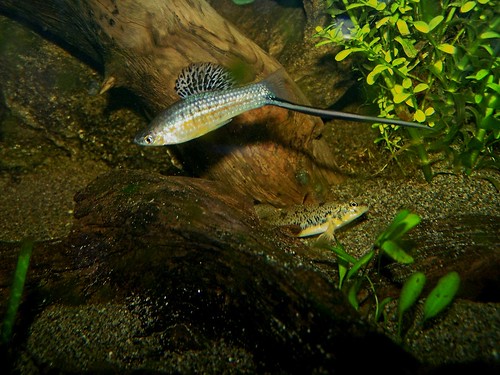
Captive Care
Montezuma sword-tails (often called "monties") are fairly easy to keep happy. They should be kept in groups with a ratio of one male to every 2 or more females. A 30 gallon long style aquarium can house a group of up to 6 adults. The aquarium should have some areas that densely planted (with live or fake plants) and some open areas. If you have enough cover, fry will survive with the adults.
Water Quality
As with all fish, stable, clean water is the most important to these pretty sword-tails. As long as the water is parameters are stable and the water is clean (no ammonia or nitrites, low nitrates, low dissolved solids) they should be able to adapt to most pH and hardness levels. Having said that, it is probably a good idea to keep their pH above 7.0 and below 8.0 and the dH between 10 and 20. They seem to handle temperatures between 68*f to 82*f fairly well. They may not breed at the lower and higher ranges, but that is just a guess. If kept in the higher range, remember to add extra aeration as warmer water does not hold oxygen as well as colder water. Also, never lower temperatures more the 2*f every few hours and do not raise them more 4*f every couple of hours. Stability and avoiding extremes is the most important thing.
Food
Monties are not picking about what they eat from what I have seen. As with most fish they do best on a variety. Use a couple of different flake foods (I suggest one brine shrimp flake, one spirulina flake and a generic tropical flake) and supplement with live foods (brine shrimp, clean blood worms, mosquito larvae, fruit flies, be imaginative!) and with frozen foods (brine shrimp, blood worms, mysis shrimp . . .). If you give them good nutrition and good water they should grow and breed for you.
Tank Mates
If you wish to keep monties with other fish, avoid mixing them with other sword-tails or platies or you may get some hybridization. They can safely be mixed with goodeids and I believe fish in the genus Poecilia. They can also be mixed with some peaceful tetras (stay away from nippers, the long swords are very tempting!), and peaceful bottom feeders such corydoras catfish. You can try a variety of tank mates, just remove any that aren't working out.
What Makes Monties So Special?
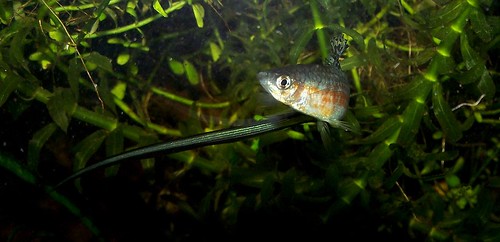
Perhaps the most stunning feature of montezuma swordtails is, well, their sword! Mature males will often have swords that are longer than their body. Even young males have long swords that usually equal the length of their body. Not only is their sword impressive, but they are not a drab fish. Even the females are nice to look at. Their dorsal fins are rather tall and they are not usually shy to display!
A Confusing Past
In the past a different fish was being masqueraded in the aquarium hobby as montezuma sword-tails. This fish was X. nezahualcoyotl. This other sword-tail has a shorter body and much shorter sword. In 1980 the true montezuma sword-tail was rediscovered in Mexico and the confusion was straightened out. Since the rediscovery monties have experienced a big rise in popularity, this popularity boom can be greatly attributed to the males extremely long sword. To read an excellent little two part series of articles on the history of the montezuma sword-tail and on the variation of color I highly recommend joining the ALA (American Livebearer Association) and ordering issue #196 and #197 of their bimonthly bulletin, Livebearers.
These guys are a gorgeous wild type swordtail. A friend of mine has a small colony of mottled monties and they are stunning! Someone was nice enough to send me some fry, so I now have some little babies swimming around my tank. They however are mostly looking to be males. I may have 2 females, but the others are boys for sure. Once they are bigger, I will probably trade extra males into the local store and order a few more females online.
Credit for the awesome montezuma sword-tail pictures goes to scott361
Friday, January 25, 2008
Montezuma Sword-Tails (Xiphophorus montezumae)

Sunday, December 30, 2007
New Filter
Fluvals

Decisions
Now it was time to make a decision, what kind of filter do I want? I wanted a canister filter, I like having them stored under the tank and I like that they don't make a lot of water noise from the return. I also wanted one that would be quiet as the tank is in my bedroom. I wanted one that was easy to take apart and clean and easy to prime. After reading different boxes and talking to a few different employees on their experiences I decided on a rena filstar XP2. I made my purchase and went home.
Rena Filstar XP2

Setting Up
Setting up the filter was overall very easy. The only trouble I encountered was getting the flexible tubing over the pipes. It involved hot water and a lot of pushing on my part, but once they were on everything else was easy. At least I know the tubes are on nice and tight! Everything else was easy to assemble and get on. There are two different choices for the return flow, a spray bar or just a spicket type pipe. You can also attach a peice that has a flow adjuster, or you can leave it off. I was dissapointed that there does not seem to be a way to put the return down at the bottom of the tank. The intake tube allows you have different lengths, but each section is about 4 to 5 inches long, so my intake is a bit higher than I would normally like it, but that is a small price to pay for the ease with which everything went together. Overall I am very pleased with how easy it was to put together.
Priming
Priming was a breeze! Once all the hoses are hooked up, you twist off a cap from the top of the intake and pour some water in. Once the water has filled the hose you recap the top, open the tubes to the canister and water wonderfully flows into the filter and fills it. According to the directions you wait 2 minutes to ensure air has left. I found after 2 minutes a tiny amount of air was left in the filter, gently tipping it to the side got it out. Then I plugged it in and it ran beautifully. I was surprised at how powerful it was, generally I have found that filters are usually not quite as strong as the box would lead you to believe, however this one was better than I expected.
After A Week
After a week of running I am still pleased with my rena filstar XP2 filter. It is running silently and seems to be catching a lot of debris. I love that it is clear and you can see into it. The fluvals have always been dark so you never new what state it was in. This one I can see wether it needs to be cleaned rather than guess. The flow is still going strong, infact I had to turn it down just a bit.
Review
So far I really like the rena, it seems to work good and most of it was easy to assemble. The only bit of trouble I had was getting the tubing over the pipes, but once they are on there they shouldn't need to come off for a good long time. Priming was a breeze.
So far so good! I will report back in a month on how it was to clean!
Fluval image from: http://www.fishtanksdirect.com/index.asp?PageAction=VIEWPROD&ProdID=1006
Rena image from: http://www.aquatichouse.com/FILTRATION%20MENU_files/Filstar.asp
Sunday, October 14, 2007
Supporting Other Hobbyists
Why Support Other Hobbyists

How To Support Them
Many people may not know how to go about supporting their fellow hobbyist. Where do you find them to support them? Well, one of the easiest ways is to join a local fish club. Another is
Supporting other hobbyists supports our hobby.
picture credits:
Saturday, September 29, 2007
A few fishy overviews
harlequin rasbora Trigonostigma heteromorpha
-I have a school of 7 of these egg layers in my 60 gallon. They are great fish, very colorful 
neon tetra Paracheirodon innesi
-These little guys are very popular. They are another egg laying, schooling fish, best in groups of 6 or more and are good community fish. They are a bit delicate and should not be put into new tanks. In fact I find people are
dalmatian sailfin molly Poecilia hybrid
-Dalmation sailfin mollies are a livebearing hybrid fish. Males have the sailfin and females do not. They get a bit large, up to 4 1/2 inches, and do best in bigger tanks (40 gallons or bigger IMO). Ideally they should be kept in groups of one male to several (2 or more) females. They can be a bit nippy at times and usually do well with larger peaceful to semi aggressive fish. They should be fed a diet high in plant matter, so alternating between regular flake food and a spirulina based food is a good idea. pH should be anywhere from 7.0 to 8.2 and temps can be from 72-80*f. Many people say they do better with some aquarium salt in the water at a level of a tsp per gallon or higher. They can even live in pure salt water. Some people have not had problems adding them to a new tank, others have.
mickey mouse platy, red platy, blue coral platy Xiphophorus sp./hybrids
-These are all various color varieties of platies. Their care is the same. Platies get about 2 
lemon tetra Hyphessobrycon pulchripinnis
-These guys are another egg layer. They are fairly resilent little guys and do best in groups of 6 or more. They can be kept in community tanks but I wouldn't put them in with any long
red tailed black shark Epalzeorhynchos bicolor (Labeo bicolor)
-These guys are a bit on the semi aggressive side, but usually only go after other bottom dwelling fish. I would not keep them in anything smaller than 30 gallons, also do not put more than 1 in a tank unless it is a large heavily planted aquarium. Also, do not put them with other fish that look similar to them. They get about 6 inches long and tend to stay near the bottom of the tank. They prefer nuetral to soft water but seem to be very adaptable. Preferred temps are 75-80*F. They will eat flake food and should be given live or frozen brine shrimp every now and then. They seem to be pretty hardy fish. Red tailed sharks are a bit shy so should be given several "hide outs" to make them feel secure enough to come out regularly.
Corydoras elegans/Corydoras panda
-Corydoras are very cute little catfish and there are many, many different species. They like to 
Apistogramma sp
-There are several apistogramma species. Generally none really make good beginner fish because they are picky about water conditions. They are dwarf cichlids and despite being cichlids are usually peaceful. They do best and should be kept in soft water with a low pH. They are usually only successfuly kept in planted aquariums. They are micropredators, which means they need a high protein diet. While many will take flake food they usually will not do well on only that. Offering a variety of frozen and lives foods will be best for them. They like warmer water (upper 70's*f). They are usually kept in breeding pairs of one male and one female. They are usually best kept with tetras or smaller rasbora species. Single pairs can be kept in 10 gallon tanks. Water quality must be maintained with these sensitive little guys.
silver dollar family Metynnis
-These fish get BIG! They get to be as big as an average sized dinner plate. They also need to be in groups of 6 or more. Generally you can start them out in small tanks as they are usually available at 2 inches or so, but eventually you may need a tank of 90 gallons or bigger (probably bigger). They are very active and will often run into the side of the tank if spooked. Keeping them in groups helps calm them down a little. They love to eat plants, and should be fed a variety of vegetables as well as a good flake food. They prefer softer lower pH water but are adaptable. They can be kept with semi aggressive fish and even with many south american cichlids if the tank is big enough. They like water temps in the mid to upper 70's (*f). They are best added to an already cycled tank. They are fairly hardy as long as water quality is kept up and temperature does change to much. They tend to get ICH if the temperature flucuates.
botia striata
-These botias are a semi aggressive fish. They can be kept with bigger tetras (2"), most 
gold gourami Trichogaster trichopterus
-Gold gouramis are a color varient of the blue gourami and can get 4-6 inches long. They can be kept singly or one male with 2 or more females. They are semi aggressive and shouldn't be
honey gourami Trichogaster chuna
-Honey gouramis are small fish, usually staying around 2 inches in length. They can be kept singly or in groups of 1 male to 2 or more females. A single one with a few other small fish can be kept in tanks as small as 5 gallons. These gouramis are very peaceful and do best in community tanks. They are adaptable to water conditions as long as the water is clean and maintained. Temperature should be 74-80*f. They can be fed a good flake food but also need to be fed live or frozen brine and blood worms to keep looking their best. They may get a bit aggressive if they decide to breed as the male protects the nest and young.
pictus catfish Pimelodus pictus
-Pictus catfish are somewhat large (5") predatory fish. They should be kept in bigger semi aggressive tanks with fish that are near equal size or bigger. They prefer soft low pH water but do adapt to various conditions as long as they are not to extreme. They feed on almost anything they can fit in their mouths, from pellets and flake food to small fish. They will usually hide during the day if kept singly, so its usually best to keep 3 or more. They are best in bigger tanks because of their size (55 gallons or larger). Other than eating small fish they are not aggressive. Do not catch them with a net, use a cup to scoop them instead, because they have spines on their fines that will catch in the net. They are pretty hardy as long as the water quality is maintained (as with any fish).
Photo credits (in order of picture appearance):
Dystopian_Optimist, &_yo, Chrischang, Whisper Photography, Chrischang, Whisper Photography, Kasia/flickr
Tuesday, September 11, 2007
Pond Predators
Many people set up a pond in their yard and sit back to enjoy it only to notice a few days later
Where Are The Fish?
The most common reason to fish disappearances are predators. People often forget that predators are still around even in urban areas and that just because your fish are in a yard does not mean they are not fair game to a hungry animal.
Meet The Predators
You may be thrilled to see a majestic blue heron flying over head, only to see it land in your yard moments later. There are many animals that will prey on your fish. Cats, dogs, racoons, blue herons, some snakes and occasionally even people can all be a problem. Identifying who it is that is making unwanted visits to your pond can be a challenge.
Is It Really A Predator?
So, some of your fish are missing, how do tell if its really a predator taking them? The first thing you should do is check your water quality. Test for ammonia, nitrite, nitrate and pH. Your ammonia and nitrite should be 0ppm, your nitrates should be ideally below 40ppm, but at least below 80ppm and your pH just needs to be stable and ideally between 6.5 and 8. Next is to look for bodies, move things around in your pond. You want to make sure the fish are 
Dealing With The Problem
Ok, so you've tested your water, looked for dead fish, have been sitting vigil over your pond for days . . . now what?
Water Quality
If you think your water quality may be the reason behind your fishy dissapearances, take action to

Options For Protection
There are several options for protecting your fish from predation. They include putting a net over your pond, adding more plant cover, putting up a scarecrow, installing a sprinkler system and then hooking it up to a motion detector, fencing in your pond and adding a fake heron. Some of these options will work for some predators and not for others. For example, netting may keep out a heron, but a racoon will often figure out how to get through it. A scarecrow will usually work for a little while but many animals will learn it is fake over time and domestic animals like cats may not even blink an eye at it in the first place. Usually the most effective method of keeping away predators is a sprinkler system hooked up to a motion detector. It is also however one of the more costly options. If you do have a predator problem you may have to try several options before you find the one that works for you. Trapping usually does not work, once you remove one animal another will simply fill its place. Putting in some kind of deterent (scarecrow or sprinkler system) or barrier (netting) is usually the best way to go.
Picture Credits go to:


